Friday, November 02, 2007

Mongoose Traveller

Mongoose Publishing is a British company that made a name for itself with D20 (the system used by Dungeons and Dragons) supplements, but is now as well known for miniatures games and other roleplaying game systems. Most recently they released an open gaming license version of RuneQuest, a variant of the original BRP system published by Chaosium. Yes, it is legal for you to build games based on Mongoose's version of BRP, and include the rules in the book.

The reviews of MRQ (Mongoose RuneQuest) are mixed. The rules aren't that much different from Chaosium's house system. Some of the changes, though, did not go down well. In particular, there's a weirdness involving characters with a skill over 100% versus a character with a skill under 100%. Actually "weirdness" doesn't cover it; the rule as written is broken. Still, those who like the rules point out that Mongoose has done a better job of supporting the rules than Chaosium.

Mongoose recently released a roleplaying game based on Michael Moorcock's Elric series of books. Chaosium published 5 versions of their own game (mostly just variants of the original) based on the same source material using their BRP system. Apparently Michael Moorcock was unhappy with what Chaosium was doing with it; Mongoose gained the license, basing it on their version of RuneQuest. Some folk said previous versions were better, but apparently Mongoose's Elric game is good, and has the advantage of covering stories published after the original six books.

Continuing their tradition of reproducing classic roleplaying games, Mongoose will be publishing the next version of Traveller, Marc Miller's classic science fiction roleplaying game. Traveller could be used as a generic science fiction game, but it gained its greatest acceptance with the far future universe it portrayed. Interestingly, when the Firefly TV show came out, a lot of roleplayers noticed more than a passing resemblance to Traveller.

Traveller has gone through several iterations, including four versions using Miller's original rule system, a D20 version and a GURPS version. Mongoose will produce a game based roughly on the original game system, but with a fair number of modifications.

For those of you interested in Traveller, you'll want to check out Mongoose's blog for more information. You can find it here: http://blog.mongoosepublishing.co.uk/.

There are a number of innovative game systems out there, including the One Roll Engine system created by Arc Dream. What's funny is how classic games like RQ, GURPS, and Traveller are still quite popular.

Tuesday, October 30, 2007

Chaosium's BRP cover less than impressive

Chaosium is releasing a new version of their Basic Role Playing system. This is the game system used in the roleplaying games RuneQuest and Call of Cthulhu. The new book combines all the rules from several games into one volume, and it's intended to be used as a generic system.

Now, I'm a fan of BRP. The system is a little long in the tooth right now, but it's a clean system and I know it very well. Even still, I'm a little trepidacious about this volume. The automatic weapon rules are the same as found in Call of Cthulhu, which is unfortunate as they are a bit broken. Also, though there are advantage/disadvantage rules for super powers, the playtesters vetoed such rules for other settings. In other words, this is not a rewriting or retooling of the game system, it's a compilation. The automatic weapon rules, in particular, worry me because the fact they made it untouched from Call of Cthulhu tells me that they were never properly playtested, and makes me worry about the usability of the rules in a modern setting.

(Yes, I have used them for modern Call of Cthulhu games, which is why I know they have problems, and why I wrote my own house rules.)

Still, I like the game system and think it would work very well as a generic system. I'm looking forward to seeing it published (even if it means yet another book produced by Chaosium that's little more than a reprint).

I hope the game sells well. It's an "old school" game system, but it's pretty elegant. Thus, I guess the intention of the proposed cover is to reflect it's generic nature, show it's flexibility, but also draw a link to the past. Unfortunately for Chaosium, the proposed cover doesn't get much love on the RPG.net site. Besides the obvious artistic issues of perspective and scale, the cover simply isn't that inspiring. I don't see anything on the cover that makes me think, "Yeah, I want to game that". Apparently most of the folks that participated on the RPG.net thread agreed.

I'll let you decide for yourself. Here's the cover:

"Portraits of America" includes Canadian landmark

No additional comment necessary:

Video claims Horseshoe Falls for U.S.

Oct 29, 2007 04:30 AM
Matthew Lee
ASSOCIATED PRESS

WASHINGTON–The Bush administration appears to have annexed a major Canadian landmark as part of a slick new campaign to promote U.S. tourism.

A Disney-produced promotional video released last week by the departments of State and Homeland Security highlights majestic American landscapes, from New England's colourful fall foliage and the Grand Canyon to the Rocky Mountains and Hawaii's pounding surf.

But about four minutes into the seven-minute video, Welcome: Portraits of America, viewers are treated to the impressive sight and sound of water roaring over Niagara Falls.

In showing the natural wonder, Disney's filmmakers, however, chose the Horseshoe Falls, the only one of Niagara's three waterfalls to lie almost entirely on the Canadian side of the border separating New York State from Ontario.

Making matters worse, a visitor to the U.S. would not even be able to get the same view of the falls in the video because the scene was shot from a vantage point in Canada, according to Paul Gromosiak, a Niagara Falls, N.Y., historian and author.

Also, he said the video leaves out the two cascades that actually are on U.S. territory, the American Falls and Bridal Veil Falls.

"This is not the United States, this is 100 per cent Canada, shot from the Canadian side," Gromosiak said. "This is an insult.''

The distinction between the U.S. and Canadian sides is clear to most people who have visited the Falls.

But it seems to have escaped the notice of the producers and U.S. officials, who presumably vetted the video.


In a separate "making of" video, Jay Rasulo, the chairman of Disney Parks and Resorts, speaks over the falls footage about the importance of showing would-be tourists "the great sites, the great vistas that they dream about all their lives when they dream about America.''

Karen Hughes, the U.S. undersecretary of state for diplomacy, said in a posting to the department's blog last week that the production has the administration's blessing.

"We're going to play it in waiting rooms and at embassy events – and we hope it will inspire many who otherwise might not have thought about travelling to America to come and see it for themselves," Hughes wrote.

Or maybe Canada.

Days of cardboard

Been too busy packing for the move to post! Up to our armpits in cardboard and packing tape. Had a yard sale on Saturday that did quite well. Alana and Logan have new bikes, as we'll be living near a park with bike paths.

Busy times!

Thursday, October 18, 2007

The Tragically Hip on Saturday Night Live

Alana and I were thinking, at one point, of going to see The Tragically Hip play in New Orleans this weekend. Unfortunately, it fell through for a number of reasons, not the least of which being the fact we're up to our eyeballs in boxes.

So, instead of going to the concert I've been listening to their music, in the car, at work, and at home.

For those who don't know, The Hip are my favourite band, and somewhat of a phenomenon in Canada, though relatively unknown outside of the country. While web surfing I was finally able to find The Hip's performance on Saturday Night Live, back on March 25, 1995. I remember this performance rather fondly. Ironically I was up to my eyeballs in boxes (preparing for a move) the weekend they played.

This was The Hip's big introduction to the U.S. market. The song is "Grace, Too", from the album Day For Night. It happens to be my favourite Hip song. I hope you enjoy it:


Video: Tragically Hip - SNL - Live

Tuesday, October 16, 2007

We're Moving!

My legs still hurt, my back is a little achy, and we're up to our necks in boxes.

Yes, we're moving! Last week we put a deposit down on a new apartment. We can move into the apartment November 1, but we still have the old apartment to December 1. We expect to move in over the course of the month, with the final move over Thanksgiving weekend.

The main reason we're moving is because we're tired of the current place.

The neighbourhood has gone downhill. The school Logan goes to is pretty good, but the middle schools and the high schools in Monroe, LA don't have a good reputation. This is particularly true of Ouachita High School, which Logan would have to attend if we stayed around here. So, we knew we had to move to West Monroe, where the middle schools and the high school are much better.

We were pretty much set on moving after the air conditioning drain pipe stuck and overflowed onto our floor. This happens yearly, but the apartment manager refuses to send someone through each year to blow it out as a preventive measure. The big burner on our stove doesn't work, the door badly needs weather stripping, and our front light doesn't work (it used to, but it stopped, and yes, we did change the bulb).

So, it came down to the fact that we wanted out of the apartment and we're unlikely to move again for a long time.

The new apartment is still a two bedroom, but it's less than two years old. It has two bathrooms, and a good sized kitchen. The living room area is a bit bigger, too. It is more expensive (the current place has price going for it) but in all other ways it's much nicer.

So why do I hurt? Alana and I were at our storage locker on Saturday shifting all the boxes out, opening them, and shifting things around. We were there all day Saturday, almost literally. We left the house a bit after 8:00 a.m., and got to the locker (after breakfast) at 9:00 a.m. We were done at 7:45 p.m. I got a sunburn on my neck, and Alana on her back. It certainly didn't feel like a whole day's work. Unfortunately it also didn't feel like we had a whole weekend off...

Anyway, now our "hobby" is packing. It doesn't help that I have to go on a business trip next month, so I'm going to lose a week. I hope to have most of our stuff packed up, and even a fair bit of it over at the new place, before then.

When we get the keys to the new apartment I'll take some pictures. It will never look as clean and tidy as it does right now!

Sunday, October 07, 2007

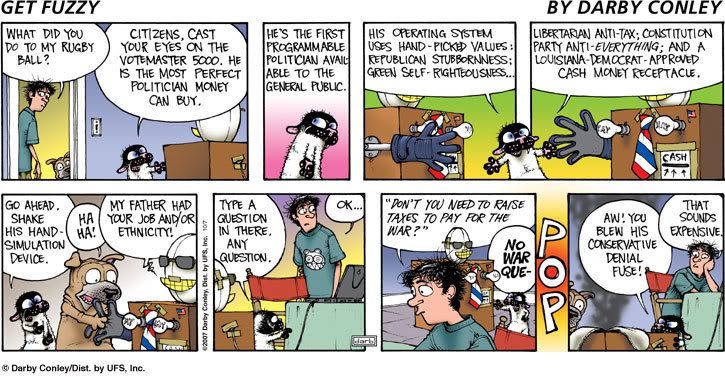
Comics get it, but the president doesn't

Get Fuzzy isn't usually this political. It's funny, though!

Get Your War On

Indy, one of the guys on the Ground Zero Games mailing list, sent a link to Get Your War On, a web comic dedicated to putting down the Bush administration.

Here's one of the strips that tickled my funny bone. Click on the picture for a bigger version:


The comic's archive is here: http://www.mnftiu.cc/mnftiu.cc/war68.html

Best steakhouse in the country?

We may have found the best steakhouse in the country. It's in LaGrange, Georgia. Take the second exit, the one by the Jameson Inn. The place is called the Conestoga Steakhouse.

We went there on our last night in LaGrange. We worked 12 hours the day before and 10 hours that day, and we were starved. We went to the Longhorn Steakhouse the first night in town and it wasn't bad, at least for a chain restaurant. The Conestoga was intriguing, so we went there on a whim.

The place is no hell to look at. It's a generic "local restaurant" built in the 60s or 70s. There is none of the original architecture common to chain restaurants. The most promising aspect of the exterior were all the cars in the parking lot.

The interior didn't instill us with much confidence. It's done in a horse stable motif. When there weren't stable flourishes, there were country kitchen bits. I seem to remember chickens on the wallpaper. There was no mood lighting, either. None of that fancy darkness except over your table. No, sir, this place was lit up like a high school football field on a Friday night.

Again, we weren't sure what we were getting into, except that the place was pretty busy with local folks. Really big local folks. The kind of local folks who require two chairs each.

The steaks were reasonably priced. All that remained was to taste them. Travis bit into his while I fixed my backed potato. He said I might not need a knife. Sure enough, I cut a piece of steak by running my knife back and forth over a few times with absolutely no pressure applied on the knife. Its own weight was enough. The stake, a rib eye, had an extraordinary taste. Succulent with the just the right seasoning. Although the steaks were large enough, I was seriously tempted to order a second!

So, if you find yourself heading east toward Atlanta along I-20, it's worth taking the extra hour by going via Montgomery, Alabama and stopping for supper in LaGrange, GA, it's that good.

Raising Cane's concept a ripoff? Say it ain't so!

Last month I trained a client in LaGrange, Georgia, about 15 miles east of the Alabama border and an hour from Atlanta. It was the most fun I've had on a business trip, largely due to the company. Travis — one of my "peeps" — attended with me, so that he could see what it was like to train someone in person. It turned out that we have an amazing amount of stuff in common. As an example, during the eight hour drive home — and half hour lunch break — we didn't bother turning on the radio once. We just yapped the whole way.

Anyway, one of the first restaurants we saw was a place called Zaxby's. When we first saw it, we thought, "Gee, that looks just like Raising Cane's." Raising Cane's is a chicken finger franchise that started in Baton Rouge in 1996. They serve chicken fingers as their main entree, and that's it. Alana and I went nuts for it when the first opened a store in West Monroe, and we got Jimmy and Jason hooked on it soon after. Recently, though, there's been a serious drop in our interest for Raising Cane's. I'm not sure why. I had it last Friday and enjoyed it, but Alana has gone almost completely off it. Jimmy and Jason aren't as interested, either. I think maybe we just OD'd on it.

So, we entered Zaxby's. That's when we discovered that it was almost exactly like Raising Cane's! Well, okay, we didn't realize this at first. Zaxby's has a wider range of menu items (mostly featuring chicken). The decor in Zaxby's was a modern interpretation of the 1920s and 1930s, while Raising Cane's is a post-modern interpretation of a 1950s diner. And, of course, Cane's ony does chicken fingers.

We ordered a chicken strip dinner, the same thing we would order at Raising Cane's. This is when we noticed some startling similarities:


  • Cane's gives you three our four battered chicken fingers made from white breast meat. Unlike KFC, the chicken isn't greasy. Zaxby's gives you the same thing, only the pieces are smaller but you get one additional piece.

  • Both serve crinkle cut.

  • Both serve their own special form of mayonnaise-based sauce. Zaxby's is mass produced and comes in packaged containers. Cane's is served in clear plastic cups with lids, suggesting that they are at least packaged at each store.

  • Both serve Texas toast with the meal.

  • Both serve coleslaw, which you can substitute for extra fries.

  • Both dispense ketchup into small paper cups. In both cases, the ketchup is on tap with the dispenser built into the surface of the counter top.

  • Both dispense crushed ice instead of ice cubes.


The comparisons were beyond eerie. It was quite clear that someone had ripped off someone else. I mean, it couldn't be co-incidence that the both had crinkle cut fries and crushed ice and Texas toast and their own special type of mayonnaise-based sauce.

I did some checking. Raising Cane's was founded in 1997. Zaxby's, which even has its own NASCAR car, was founded in 1990. Oops! It looks like Raising Cane's is a direct steal from Zaxby's (though, perhaps, with the added wrinkle that they would only specialize in chicken fingers).

What's the verdict on taste? The sauce was no contest. Cane's sauce is better, though it wasn't like Zaxby's was inedible or anything. The chicken was a little less obvious. At first I gave Cane's the win. Their fingers are bigger, a little juicier, and seemed a little less crispy. However, we ate at Zaxby's twice that week, while I can't do Cane's more than a couple of times a month (and we went from monthly with our roleplaying game group to maybe once every four or six months). Zaxby's chicken fingers seem to sit lighter in the tummy.

So, overall — and though I hate to do it — I would have to give Zaxby's a slight nod. I can see how some folks would prefer Cane's chicken, but it can't be just coincidence that four of us have taken less of a shine to them in recent months. Added to my disappointment that Raising Cane's is not as original as I thought they were, our estimation of the chain has dropped a bit since those heady days of two years ago when they first opened in West Monroe.

News roundup

While I was busy writing, a whole bunch of blog-worthy stuff happened that I had to ignore.

Locally, there was the Jena 6 protest in Jena (pronounced "JEE-na"), Louisiana. Not much to add at this late date, other than to say that there as a whole lot of anti-black paranoia among locals. One person at work asked if we were "ready for the looting". Apparently white Jena residents ran out of town, afraid of what would happen. (The protests were mostly peaceful.)

I'm of two minds on the attack myself. On the one hand, it seems that the local justice system treated various incidents too lightly until it looked like a race war was developing, at which point they treated the next incident severely, an incident that just happened to include black kids. On the other hand, inequality doesn't justify six kids beating up another kid. On the other, other hand, what's the point of having one set of laws for kids and another set for adults when you choose to try kids as adults seemingly on a whim?

The biggest issue is that the actual events of the affair is not well known, largely due to the filters applied by the people repeating the story. The Jena 6 are not the martyrs that is now being portrayed. The local portrayal (which I've seen on news sites and in the office) that this is another "O.J." (i.e. blacks playing the race card to get away with a crime) is very wrong, and just masks the general level of racism that's common in northeast Louisiana.

The best account of the incidents is this article from the Associated Press:
http://ap.google.com/article/ALeqM5jOl6L858y0iDf4k_28ojhYLcuLGg

On the national level, Alberto Gonzales quit. I'm actually surprised at this. I didn't think Gonzales would remember how to write a resignation letter.

On the international level, the Canadian dollar is now trading at a higher level than the U.S. dollar.

First, the serioius part. The fact that the Canadian dollar is worth more than the U.S. dollar is not readily understood by Americans. Part of the reason for the higher Canadian dollar is a need for Canadian dollars to purchase Canadian oil. Another reason is because problems with the U.S. economy mean that outside investors no longer think the U.S. is quite as good a place in which to invest. Gee, you think maybe giving tax cuts to the rich while paying for an expensive and unnecessary war, and the resulting explosion in the deficit, isn't a good idea?

On a less serious note, I am now officially accepting apologies from all those Americans who made fun of the 65¢ Canadian dollar a few years ago. Please post your apologies here. No, it's okay, I'll wait...

There were other items, but I'm too tired from watching the Grand Prix of China (and despondent over Lewis Hamilton's big mistake that stopped him from finishing and might just have cost him the Formula One championship) to go into them right now.

He's alive!

Howdy, folks!

Yep, I'm alive and kicking!

I finished the manuscript for This Favored Land, the American Civil War supplement for the Wild Talents roleplaying game last week. I was technically late, getting it in about 12:30 a.m. on October 2 (it was due October 1), but everything was cool.

I wish I had about another two weeks to work on it. I didn't have the time to sit back and not think about it for a week and then go back and edit it. I know it will need some editing, maybe some substatinal editing. On the other hand, Alana said to just forget about it for a while. She realizes I'm second guessing myself.

I wish I had another 10,000 words. I had to strip out some good stuff that I wanted to leave in. I didn't get a chance to write a couple of things I wanted to include, such as what it was like to be a sailor during the Civil War. There were a couple of really cool bits, like the loading procedure for cap and ball pistols, that I had to strip out for space reasons.

I'm sure the manuscript will require some heavy editing. I was writing it in a vaccuum, as far as what the publisher wanted. Did I focus too much on the backgrounds of the four groups I created? Was there too much information about life as a soldier? Is the adventure good enough for inclusion, or should it be scrapped?

The adventure was the hardest part to write, which was surprising. I realized part way through testing that my home-grown scenarios are designed with my group's characters in mind. Writing a generic scenario isn't easy. The location is pretty interesting (Missouri), but it's not where I would set a long term campaign of my own, which would either be set in New Orleans, or as a spy campaign in Virginia. I also sort of wich I had created a scenario set in the mountains of North Carolina (I have a thing for hill and mountain country) but I thought that might come out a bit too much like Cold Mountain. I ended up re-writing most of the scenario in the last two weeks based on playtesting. I think the adventure is tighter now.

There's nothing to do now but wait for the feedback, at which point I'll probably be back into heavy-duty writing mode again. I'll keep you posted.

Wednesday, September 05, 2007

Scifi info

I enjoyed The Dresden Files on SciFi (the science fiction channel) this year. It wasn't perfect, by any means. I found the tendency for Harry Dresden, the main character, to get into fights by the end of the second act to be too formulaic. Still, the story about a modern day wizard detective (based on the novels of the same name) was interesting. It was also filmed in Toronto, which brought a smile to my homesick lips.

It's been cancelled. Figures.

In the spring SciFi ran the show Painkiller Jane, a stupid title for a show about a near invulnerable woman working for a shadowy government agency (a cheap ripoff of Nikita, which itself was based on the French move La Femme Nikita). The show was about as stupid as its title, at least that's the feeling I had from watching the premiere episode. It's been cancelled, too. Good, because it didn't deserve to stick around after they cancelled Dresden.

This summer SciFi premiered an updated version of Flash Gordon, based loosely around the film that came out in 1980. It even used the same theme song by rock group Queen. It had potential. I saw the first episode. So did a lot of people, as it had the strongest ratings of any new SciFi show this year, suggesting it would be around for a while.

It was awful. The acting was horrid, the writing was about as bad as the acting. It looked like it was filmed by a high school film arts class.

Fortunately, it's been cancelled, too, and much quicker than the other two shows. This is good, because it didn't deserve to stick around after they cancelled Painkiller Jane. Yeah, it was that bad.

I learned some new stuff about Battlestar Galactica. If you only remember Battlestar Galactica from the campy show from the 70s and 80s (I actually paid to see the pilot in the theatres), you've been missing something good. It started as a miniseries based on the show but much darker and a lot better produced. Edward James Olmos and Mary McDonnell are the most well known actors in a very good cast.

The series is set in another part of the galaxy, where the people worship the Greek gods. They have legends of a lost tribe that settled on a far away planet called Earth. The humans built sentient machines, called the Cylons. The Cylons rebelled, destroying most of humanity with nuclear weapons. The survivors escaped in a hodge podge (known, officially, as a "rag tag") fleet of ships, including an aging battleship/carrier known as a "battlestar". The fleet is looking for a new home, and the ultimate destination is Earth.

Anyway, the season ended this spring with a cliffhanger. The new season wasn't supposed to start until early 2008. That's not quite the case, now. They are playing a telemovie, called "Razor", in November. Then the season will run in the new year. They're splitting the season in half, with a cliffhanger separating the two halves. The big question is the length of time between the first half and the second half. Jamie Bamber, who plays Lee "Apollo" Adama, said that the gap between the two halves will be long, perhaps as much as 10 months! Recently rumours have surfaced that it might be as short as a month.

Where did I get all this neat information? Syfy Portal.

Tuesday, September 04, 2007

Jessica Alba's attractiveness not good science

About a week ago, a "science" article was released in various newspapers "proving" that "actress" Jessica Alba is attractive for scientific reasons. The article implies that researchers measured her hip to waist ratio and found a number that gives her the best wiggle when she walks. This, they said, is why she's attractive.

Here's an example of the article: http://www.telegraph.co.uk/news/main.jhtml?
xml=/news/2007/08/25/nwiggle125.xml


This "study" was released as a mixture of science and entertainment. As it turns out, there's not a spec of science in the story. It's a bogus survey produced by Veet, a hair removal company.

Ben Goldacre writes a column for The Guardian newspaper in Britain titled Bad Science. Goldacre reports on stories reported in the media as true when they are actually, well, bad science.

In the case of the Jessica Alba story, Goldacre actually received an e-mail from Veet. According to the e-mail, they already knew what they wanted the survey to say. They asked:

We are conducting a survey into the celebrity top 10 sexiest walks for my client Veet (hair removal cream) and we would like to back up our survey with an equation from an expert to work out which celebrity has the sexiest walk, with theory behind it. We would like help from a doctor of psychology or someone similar who can come up with equations to back up our findings, as we feel that having an expert comment and an equation will give the story more weight.


In a follow-up e-mail they admitted:

We haven't conducted the survey yet but we know what results we want to achieve. We want Beyonce to come out on top followed by other celebrities with curvy legs such as J-Lo and Kylie and celebrities like Kate Moss and Amy Winehouse to be at the bottom eg - skinny and pale unshapely legs are not as sexy..


The story said that the study came from Cambridge. Well, sort of. They went to Cambridge University and got a mathematician to analyze the data. There is no hard data in this survey at all. In other words, it's completely bogus.

Here's Ben Goldacre's column: http://www.guardian.co.uk/commentisfree/2007/sep/01/1

Sunday, August 26, 2007

Actually did some gaming!

I was a bit homesick this past week. Not homesick for Toronto (though I do get that from time to time), but homesick for GenCon. I attended GenCon in Milwaukee, the largest game convention in North America, every year from 1995 to 2000. I waited in anticipation all year for those five days of GenCon. I've never felt so in tune with a place as at that game convention. GenCon ended last weekend, but last week all the GenCon reviews were hitting RPG.net. I tried to avoid most of them...

My hobbies have taken a back seat to my writing this summer. I'm enjoying writing, but I'm also looking forward to finishing this book so that I can do different game related stuff. In particular, I need to get some miniatures painting done.

The only gaming I've done is playtesting for This Favored Land, and a weekly (though due to scheduling conflicts it's come out as bi-weekly) game of Call of Cthulhu with friends on Skype. Three of us in our monthly roleplaying group also got to play Carcassonne: The Discovery a little while back. That's been it all summer, until this past week.

The Skype game has worked surprisingly well. Each week we seem to have some sort of technical problem, but I suspect it's because two of the players — Chris and his son Josh — play from the same house, sharing the same internet connection. I'll know better in a couple of weeks when Josh goes to college. The group plays well together, and there's something about a game over a VoIP line that focuses everyone. It's worked much better than I thought it would. Our monthly playtesting sessions have been fun, at least from my perspective. I'm a little less relaxed playing This Favored Land than I usually am, probably because I'm more analytical about the adventure. We had a pretty exciting episode last month, and I hope to capture the same excitement next week.

That was all the gaming I'd done until this past week. One of the folks at work is interested in history. We keep talking about going over to Vicksburg to visit the military park some time. His 12 year old son is into the Civil War. Last year I mentioned the game Memoir '44. He bought the game for his son, who loved it. They've been playing it off and on ever since. We decided to get together last Monday and play a game or two. He suggested he bring his son. At the last minute, his brother-in-law showed up, too. We ended up playing a game of Battle Cry (his son's side won in a squeaker) and Memoir '44 (which I won in a game that was almost as close). They enjoyed it so much that we're going to do it again, though no date has been set.

They also want to play a miniatures game. The likely game will be an American Civil War game. I have a lot of painted infantry for this (which I purchased about 8 years ago), but I don't have any artillery, cavalry, or leaders painted. I think they would also like a World War II game. Logan is interested in a World War II game, and I painted some 16 German tanks earlier this year. I started work on the Russians in the spring, but the book has curtailed my painting. I need to finish off the 16 Russians so we will be able to play. As you can tell, once the book is written I've got a bunch of miniatures to paint!

Last night Logan, Alana and I played a game of Carcassonne: Hunters and Gatherers. This is the first board game the three of us have played in a long time. I think we're going to play another game today, too.

On the roleplaying front, I have some ideas I want to try out. Once the the playtesting for This Favored Land is done, I'll be running a Call of Cthulhu campaign. This will be low impact, as it's likely to be a campaign I've already run. Jimmy has asked to run a D&D 3.5 game for us as our second game. This will let me play in a game for the first time in about eight or nine years. I'm looking forward to it, even if it is D&D (not exactly my favourite system). The time I save not having to prepare for a game will let me spend more time painting and writing. I also have an idea for another Skype game, if we can get the players.

It looks like I'm finally getting to play some more games, a trend I hope continues!

On The Lot is over!

On The Lot is finished, probably quite literally. I ended up watching it until the second last week, when I turned it off in disgust.

It wasn't too bad for most of its run. Each week they had five or six short films by the contestants. They would run a 30 second spot showing the contestant producing his or her film, then they'd run the film, then Carrie Fisher, Gary Marshall, and some movie making guest would comment on the films. Carrie Fisher was an okay judge. The guest judges were usually the most brutally honest. Gary Marshall was a rambling waste of oxygen (as was his sister, Penny, when she took over one episode). Some of the films were pretty good, some were awful, but it was usually pretty entertaining.

I hoped to see longer films in the second last episode. They were down to three film makers, so I thought, "Cool, they can produce films that were twice as long." I thought it might be hard for them to do a longer film with only a week between episodes, but I figured they'd have some way to do it. At the very least I thought they'd do a regular length film while a crew filmed the contestants, showing you more of the process involved in making a movie. Either option would be interesting. Instead, they decided to insult the audience.

Every week the contestants would shoot a film and play it on the next episode. Not so for the second last episode. Instead of double length films or even three new films, they had the contestants pick their two best films from previosu episodes and they reran those. That's right, the penultimate episode, where they wanted to encourage people to vote for the winner, was a greatest hits show. I was so upset at the travesty that I shut off the TV right then and there. A number of people on the show's web site were peeved, too. I didn't bother watching the final episode. I did turn it to the channel just in time to see who won, and then I turned it off again.

This was a mess of a show from the beginning. It was patterned after American Idol when it should have been patterned after Top Chef or even Project Greenlight. They blew the opening episode by not showing any movies. The first set of movies turned out to be the contestants' sample movie (the movie they made to get into the show) even though it wasn't advertised as such. At least one of the films was essentially a ripoff of two old Twilight Zone episodes, but none of the judges caught it (and praised the film instead). The second place winner produced a film early on that was offensive to people with mental disabilities, yet he still made it to the final two. And there was the insult in the second last episode. They did pretty much everything they could to wreck the show from the get go. The ratings were poor, so it's highly unlikely that there will ever be another On The Lot. Funny enough, I'm okay with that.

Writing progress

Work continues apace on This Favored Land for the Wild Talents roleplaying game. I lost essentially two weekends of work due to allergies. I've made up some time this weekend, though. Obviously my plan to finish most of the writing by the end of August and then spend September editing it isn't going to happen. That was a bit aggressive anyway.

The first chapter has been more difficult than I had thought it would be. It's the "splat" portion of the book. A "splatbook" is a roleplaying game supplement that focuses on a particular group in the roleplaying game's universe. The term "splatbook" comes from the way these books tend to cover a particular faction in the universe. White Wolf's vampire books are like this. They did a bunch of books on vampire clans that were named "Clanbook *", such as "Clanbook Tremere" and "Clanbook Brujah", etc. The "*" represents a "wild card" indicator in computers, or "insert word here". An asterisk looks like a smashed bug, so it's sometimes called a "splat". This is a long way of explaining that chapter one covers The Gifted (the people with super heroic powers), and four different groups that arose from the appearance of these super powered people. This requires the most imagination, and the most "refactoring" as I started writing each group's description. I stalled on a couple of the groups because my original ideas just didn't work once I started explaining them. I will have this chapter done tonight (with the exception of some character statistics, which I'll do later this week).

The second chapter is finished. This is the rules chapter that explains how to create characters. Chapter 3 is done, too. This is the chapter with the rules specific to the Civil War, including Civil War era weapons. I'm about 3,000 words into chapter 5, which is the "what was it like to live during the Civil War" section. Later today I will start on Chapter 5, and maybe even finish it. Chapter 6 is the "campaign" chapter. It gives the game master ideas for using the book. Chapter 7 is the introductory adventure. It's mostly done. I just have to write up the climax of the adventure, which I have in my head. I'm debating waiting until after next weekend to do that, as we should finish our playtesting of the scenario at that point. Chapter 8 is the references chapter and that's done. This leaves chapter 4. Chapter 4 is a timeline of the Civil War. It will be written like a journal, listing the major events of the war. In addition, there will be sidebars — which we envision will appear as hand written notes — describing activities of The Gifted. I hope to begin this in a couple of weeks.

It's been an enjoyable run, if a little frustrating at times. Now I'm getting into the stuff that will take less time to write, so I expect to see an acceleration in my writing in the next few weeks. I plan to take a vacation day the day after Labour Day. I'm also a bit concerned over the amount of time I'll have for writing the week after that, as I have to travel to Georgia to train clients. I certainly won't be bored...

Thursday, August 23, 2007

My dice type!

It's been a month since I posted? Wow...

I'm not posting much today, but I'll do a longer blog entry on Sunday (while I'm watching the Turkish Grand Prix).

For now, I thought you'd like to see what kind of polyhedral die I am!


I am a d10


Take the quiz at dicepool.com


Here's what it said about me:
Ah, the d10! While you aren't actually a true regular polyhedron, you are the only die that makes logical sense — metrically speaking. Chances are, others see you as over-analytical or a goody-goody. While that may be true, you also have a gift for patience and tolerance. Growing up you probably had a calculator wristwatch that you never really needed to use (since you were faster on your own), and you probably aced all your classes (except for gym). You use the metric system almost exclusively, but are able to quickly convert in mid-conversation for the sake of your backwards Imperalist friends. You've coded in at least two different programming languages, and have created more original gaming systems than you'll ever admit. You're generally not a show-off, but you do take pride in being called either a geek or a nerd.

Sunday, July 22, 2007

Steady progress

I'm watching the European Grand Prix (Formula One racing, of which I'm a big fan) on video right now. The coverage was over almost two hours ago, but I didn't get up in time to watch it live. So far I haven't missed a single race. I saw several live (including the Australian Grand Prix, which ended at 4:30 in the morning back in April), but most on tape. It's been a great year for Maclaren fans (of which I'm one). Maclaren is in the lead in constructor points, and young Lewis Hamilton ha been having a great year (this race not withstanding). It's been an excellent F1 season.

So how have we been doing? Okay, I guess. Logan is about three weeks away from going back to school, which still throws me as I'm just now (mentally) used to us being in the summer. This has been a weird summer, as I've been busy working on the roleplaying supplement pretty much every day.

As some of you may be wondering, the book is going pretty good. I'm not as far along as I'd like, but I've been concentrating on the truly creative parts of the book, the parts I knew would take the most time. This means that for the rush to the end I'll be mostly writing historical facts, which takes a lot less time.

I hope to be at the 40,000 word mark by the end of today. I finished the chapter on the combat rules (which is going to end up about 10 pages long instead of my estimate of 4!). The introduction and reference sections are done. I'm mostly finished the adventure, which is the last chapter of the book. We're playtesting it, with one session under our belts and another planned for next weekend. I know in my head what will happen in the adventure; I just have, oh, 6 pages left to write, plus the stats for the non-player characters.

I'm currently finishing the first chapter. The book is based on the idea that super-powered humans (we're not talking Superman abilities here, but more like psychic powers, and the bending of the laws of physics, rather than the breaking of those laws). This is the chapter describing "The Gifted" (the "parahumans" of my universe), the Ethereals (a physical manifestation of The Gift), and the four organizations directly affected by The Gift and The Gifted. I originally had five organizations, but I'm going to have to drop one for space reasons. I can always write it up and release it in a PDF or something after the book comes out. In fact, I have enough ideas running through my head that I might throw a couple of ideas into a PDF file.

Each of the sections I've written has gone over my estimated word count. I'm not that worried about it. I know I'm going to have to trim stuff out of the final manuscript. I expect to have to trim at least 10,000 words some time in September, for an early October finish. When I signed the contract, that date seemed such a long way off...

That's it for this post. I have a lot I'd like to talk about, just no time to do it! Not when I'm spending time watching F1 races! This one has been a good one, though. Incredibly wild with a downpour early in the race, and rain for the last couple of laps. Maclaren came in first, with Fernando Alonso just beating Massa's Ferrari. That puts Alonso within 2 points of the phenomenal Lewis Hamilton, who is leading the championships in his first F1 season. Hamilton was thrown into 10th place due to a mechanical problem in qualifying, and then he fell to 17th after he went off the track due to the rain, but he still finished a respectable 9th. It's going to be an interesting finish to the season.

Okay, enough of that, back to writing...

Tuesday, June 26, 2007

What is roleplaying?

It's been a month since I blogged. That's because I've been steadily researching and writing This Favored Land, an American Civil War supplement for Arc Dream's Wild Talents roleplaying game. My writing output has dropped considerably on the project this past week, but that's because I've been doing an awful lot of research. I now know more about the antebellum South, the Civil War in Missouri, 19th century ghosts, and the Spiritualism movement than I ever thought possible! I'm taking tomorrow off work to do some writing. By this weekend I should be back on track. (By "on track", I mean that I'll have the first draft of the 80,000 word manuscript done by September 1. This will give me a month to polish it and reorganize it before it is ready for submission.)

In the meantime, John mentioned in a response to one of my blogs that he wasn't sure what I meant by a "roleplaying game". So, I thought I'd take a short break and explain roleplaying.

---

A roleplaying game is make believe for teens and adults (kids can roleplay too, but most child activities are already essentially unstructured roleplaying games). Since "make believe" is child stuff, adults have to add complicated rules to make it "mature" and acceptable. Then, they strip out those complicated rules and give it a fancy label like "diceless" or "rules light", bringing it back to make believe but with an adult label.

Roleplaying consists of people pretending to be somebody else. It's acting, essentially, but usually without all the body movement of acting. You'll sometimes hear about roleplaying in the work place. Corporate consultants started using the idea in the 90s, about a decade after psychologists discovered it, but gamers were there first. (At least I think so; this is all subjective based on my own experience.)

In a roleplaying game, one person takes the part of the gamemaster, or GM. She (the convention in roleplaying books is to refer to gamemasters as "she" and players as "he") acts as a combination referee, story writer, and movie director. The GM's job is to create a world — or use one that's already been published — where the game takes place, come up with a story — or use a published story — for the players to play, and then adjudicate what happens based on the players actions. The story is also called an "advenure" or a "scenario". A gamemaster is also called a referee, a storyteller, and a host of other game-specific names (from Dungeon & Dragons' Dungeon Master, to Spycraft's Game Control, to Call of Cthulhu's Keeper of Arcane Lore &mndash; Keeper, for short). "Game Master", or GM, is widely used as the generic name for this participant in the game. Wild Talents uses the term "GM".

The other participants in the game are the players. They take on the persona of a character within the game. A character might be a 1920s Sam Spade-like detective, or he might be an Elven warrior from Middle Earth. He could be captain of a starship, or sailor on a World War II submarine, or a superhero, or just an average guy walking down the street. The universe where the game is set will dictate the kinds of characters a player can create. There are roleplaying games licenses for literary and movie fiction. Yes, you can play a Jedi in the Star Wars universe, a starship commander from Star Trek, or a "double-O" agent from the James Bond films. These are all popular, but games based on deeper background universes tend to be more popular.

The GM invents a story in whatever universe the game is set. For instance, if the game is Spycraft the universe is a world very similar to the James Bond movies (and if the game is the James Bond Roleplaying Game, the universe is exactly like the movies). The players are going to take on the role of spies, and the GM's adventure will be a story about what happens to those spies. If the game is Sidewinder, the universe is the American Wild West of the 19th century. In a game of Sidewinder, the characters are likely to stop gun-toting bank robbers, or thwart the plans of evil cattle barons.

The universe doesn't have to be based on reality, though it often is. Call of Cthulhu is set in the 1920s, but where the monsters of H.P. Lovecraft's fiction are alive. Dungeons & Dragons is often set in fantasy worlds not unlike Tolkien's Middle Earth (and, yes, there are roleplaying games actually set in the world of The Lord of the Rings). There's a Star Wars roleplaying game, a Matrix roleplaying game, and roleplaying games based on Buffy The Vampire Slayer, Firefly, Conan the Barbarian, Sherlock Holmes, the Second World War, DC and Marvel comics, and Hong Kong action movies.

The GM's story moves the game along. The GM might invent a murder mystery and the players' characters have to solve the mystery. The GM might send the characters on a quest to save a kidnapped princess. The characters may have to stop a terrible monster in the wilds of New Jersey, or the wilds of Mordor. The GM puts together the story, complete with clues and a cast of characters. Usually the GM figures out a way for the characters to get through the story, too, but that's just in case the players get stumped.

How much direction is required by the GM depends on the type of story. Some games are essentially miniatures wargames. The GM creates a map of an area, writes down where the monsters appear, and then the players move through the area killing evil things. After the set up, there's very little for the GM to do but move monsters and roll the dice to see if they hit and damage the characters. Other games require more GM control. In these games the players interact with the non-player characters (called NPCs) of the universe, asking questions, befriending them, or making enemies. The GM has to take on the persona of each NPC. Some games feature players competing against each other in big political or conspiratorial games. In these settings the players run the whole thing pretty much by themselves, with the GM acting as referee and the source of plot complications.

The players "generate" their characters. This is where the adult rules come in. It usually involves dice, and most often it involves dice of more — or less — than six sides. Four, eight, ten, twelve, and twenty-sided dice are all common. The rules use dice to come up with various attributes for the characters, depending on the game system. Some game systems don't use dice to generate characters, but give players points that they spend on various attributes. Some games even use a combination of points and dice rolls.

The attributes might indicate the character's strength, how clumsy he is, how smart, or how good looking. Some games go so far as to generate eye and hair colour, and the character's exact height and weight (but this sort of detail is usually left to the player to invent). Most modern games also have some sort of skill list. These are things the character can do. The player might not be able to repair a computer or speak Chinese, but his character could. The game rules give every player a fair shot at creating a character they like, with enough abilities to be interesting but with room for growth.

After the characters are created, it's off to play the game. The GM will describe the setting of the game. At some point the GM will ask each player what they are doing. The player tells the GM, and the GM lets them do what they said they were doing, or tells them they can't do it, or uses the rules to figure out whether or not they can do it.

For instance, if the game was set in the Wild West, the players might all be cowboys. The GM would describe the saloon where they are congregating. The GM would then say something like, "The local sheriff runs into the saloon and yells, 'The afternoon stage coach has been held up! I need a posse!'" The players would then have to decide what they are going to do. Are they law-abiding citizens who will get their horses and help the sheriff? Or are they bank robbers who will take the opportunity to rob the bank while the posse is gone? Or perhaps they'll just sit in the saloon, minding their own business, until something else happens. Let's say they all go to help the sheriff. While riding out to the stage coach they are shot at by bandits. One player wants his character to jump off his horse and crawl for cover. Another wants to shoot a bandit while remaining on his horse. Can the characters do these actions? Can the first player jump off his horse without hurting himself? And if he is hurt, how badly? Can the second character shoot the bandit? This is where the rules and the dice come in.

The GM's job is to make sure everyone has fun. Except for a rare number of games that have competition as a premise, the other players do not compete against the GM (although there is a great deal of pleasure taken from outsmarting the GM's story). The players pretend to be their characters and participate in the story as though they were actors in a play. It's like reading a book or watching a movie, but with the players participating. It's like make believe, except that the GM tells the others whether or not they can do a stated action, and how well, using the game system's rules as guide.

The GM might dictate that the character on horseback can't shoot at the bandit because it's too hard to hit while riding. Usually the game rules will cover this situation, but if they don't the GM has to figure it out by herself. She may even "cheat" for the sake of the story. Perhaps the bandit is Black Bart, who has to make it to the next town in order for the story to work. The character shoots at Black Bart, hitting him. The GM might roll the damage herself, so that Black Bart will miraculously survive. Or she might have Bart duck at the last second. Or, she might just let the player roll the dice and if Black Bart dies, he dies. Then she might have to change her story altogether, on the fly. Perhaps Black Bart was going to ride to the next town to hole up with his brother. Now her story changes, and Black Bart's brother is going to want revenge on the man who shot Bart.

The fun in roleplaying games comes from pretending to be a character and doing things that are impossible in real life. Players are encouraged to talk like their characters. A player playing a cowboy could tell the GM, "I walk up to the sheriff and ask him if there's any reward for joining the posse," but he's encouraged to do something like, "I'm going to walk up to the sheriff. 'Say, sheriff, there any reward for capturing this here Black Bart gang?'" The GM would then interact with the player by pretending to be the sheriff. This is where NPCs come in. The GM plays the part of every NPC in the game, acting like that NPC and dictating what the NPC does. The GM will take on the role of the Sheriff, Black Bart, and that cute saloon girl the cowboys have their eyes on. The GM tries to make them feel like individual characters.

Because the GM runs the NPCs, the players never know what's happening behind the scenes. Maybe the sheriff has been bribed by Black Bart. Maybe Black Bart is a Pinkerton agent under cover. The players will never know unless they dig into the story.

Another key aspect of roleplaying is the ability to dictate the direction of the story. There are roleplaying games for computers and game consoles, but they tend to be "linear". The player usually has to follow the script to get through the story. So called "pen and paper" RPGs have a human deciding the outcome, but that human can change the direction of the story at any time. Often a better story comes along when the players do something the GM hadn't thought about. For instance, one player might say, "Hey, what if we found out where Black Bart's girlfriend lived and wait for him to appear!" In a video game the designers likely wouldn't give the players this sort of freedom (not yet, anyway). In a pen and paper game, this sort of alteration on the fly happens all the time.

The style of play is different from one game group to another. One group may use miniature figures and a dry erase board for a map so that they can tell where any player is at a given time. They can glance at the board and see that one character is standing by the piano while another is near the stairs when Black Bart enters the saloon. Other groups might not bother with miniatures and just keep the action straight in their imaginations. Some groups like murder mystery stories, whether they are straight detective stories or based around some kind of horror element. Other groups just want to be heroes, like Conan or Captain Kirk. Some groups want intense realism (if they shoot someone they want to know what organs and bones are hit), while others emphasize speed and flexibility. A lot of game groups jump from style to style, wanting a realistic game set in World War II but a fast paced, heroic game when playing games set in Hong Kong action movies, as an example.

After an adventure is completed, the characters are usually rewarded for the way their players ran them during the game. This is usually in the form of experience. Characters will improve at skills, and sometimes attributes, as the game (known as a "campaign") continues. This gives players incentive to keep playing the same character. It also gives players an incentive not to just throw the character away doing stupid things. If a character dies, the player will usually have to create a new character from scratch, losing all those hard won experience points or skill increases. Players usually develop a fondness for their characters, which also helps mitigate against doing stupid things. The game does not prevent you from doing stupid things. If you want to try and dismantle a bomb by shooting it from five feet away, there's nothing in the rules stopping you...

In roleplaying there truly is no winning or losing. It really is all about how you play the game. (Okay, there are competitive roleplaying games. Rune, a Viking game that's actually based on a console game has the players actively compete against each other, but it is the rare exception rather than the rule.) Sure, an entire party might be killed off by some monster in Victorian London, but if it was exciting and heroic, and the players killed the monster too, then they could very well feel like they "won". The idea isn't to win like in a conventional game, but to enjoy the story that the players and the GM mutually create.

As I said, it's make believe. With rules. And usually dice.

So far I've written about what you can do in a game, but I haven't explained how the game is actually played. How do you tell if you shot Black Bart, or how do you determine how badly hurt you were jumping out of a window? That's where the rules come in.

Roleplaying games have two main parts to them: the game mechanics and the game universe.

The game mechanics control how the game is played. These are rules that tell you how to create a character, how long a "game turn" represents, how far a character can move in a turn, whether or not a character can shoot a target with a gun, whether or not a character can cast a magic spell, etc., etc. These are the rules that dictate if a character can do something and how well they succeeded at doing it.

Game mechanics come in many forms. Some games have "character levels", where characters don't rise in ability until they've accumulated enough experience points, and then *poof* they suddenly jump up to the next level. Often in these games, every character of the same type (or "class") at the same level has roughly the same ability. This was how D&D worked.

Some games give characters skills, with each skill representing the character's ability in one area. Each character can have a unique combination of skills and skill abilities. One character could have a high score in the Read Chinese skill but a poor score in their Pistol skill, while another character could have a high Pistol score but no ability in reading Chinese. In these games, characters increase abilities in the skills a little at a time. T

There are also games that use both character levels and skills, and games that don't use skills at all.

Even when games have a similar method of handling character abilities, like having a list of skills, the actual method of determining outcomes is different. The game company Chaosium calls their rule system (or, rather, their primary rule system, as they've had several over the years) BRP for Basic Role Play. Characters have skills rated from 0 to 100. To attempt a skill you roll two 10-sided dice. One is usually numbered from 0 to 9, and the other is numbered 00 to 90 by tens. You roll both dice and read the 00 to 90 dice as the tens digit, and the 0 to 9 as the ones digit. This gives you a number from 1 to 100 (actually 00 to 99, but 00 is treated as 100). To succeed at a skill you have to roll less than or equal to your skill rating. If I have 60% in my handgun skill, I will have to roll 01 to 60 in order to shoot Black Bart. If I roll 61 to 100, I missed.

This is only one type of rule system. The most popular system in the world is the D20 system ("D20" standing for "20-sided die"). It's popular because it was based on the first major roleplaying game, Dungeons and Dragons. To succeed at anything you roll a twenty-sided die. The specific situation results in a target number. You want to roll equal to or greater than the target number. Skills and special abilities add bonuses to what you roll, raising the number.

Steve Jackson Games' GURPS (Generic Universal RolePlaying System) gives characters skills of 0 to 18 (roughly). The player rolls three six-sided dice, adds them up, and compares the result to their skill. Like Chaosium's system, rolling low is good and rolling high is bad. Arc Dream's Wild Talents is entirely different. Characters have "skill levels" from 0 to 10, and they have attributes (Body for physical ability, Mind for intelligence, etc) in the 1 to 10 range (with normal humans between 1 and 5). A player rolls a number of 10-sided dice equal to the sum of the character's skill and the attribute associated with it. They succeed if at least two of the dice roll the same number. The more dice tat match, the quicker the character succeeded at what he was doing, but the higher the number on the matching dice the better the result. (Yes, this may seem a little odd, but it works!)

The game universe is the background in which the game is played. If it is a Star Wars game, then the game is set in the Star Wars universe. If the game is Call of Cthulhu, the game is set in world as it was in the 1920s, with H.P. Lovecraft's monsters running loose. The universe can be a published roleplaying product, it could be a world taken from a book the GM read, or it could be something the GM made up all by herself.

Sometimes the game universe and the game mechanics are strongly connected, other times they are weakly connected. This is a difficult concept for a layman to get their head around, because if all you've ever played are board games you are used to the whole thing coming in one package. Here is an example that will hopefully help.

Most folks have heard of (even played) Monopoly. You can buy standard, every day Monopoly based on the streets of Atlantic City, New Jersey. You can also buy, believe it or not, Star Wars Monopoly. The rules are pretty much the same, but the board and pieces are different and are based on the planets in Star Wars. You are still playing Monopoly, it's just that the setting is different.

Let's look at the board game Risk. You have regular Risk, set in the 19th century, and you have... you guessed it... Star Wars Risk. Same rules, but a different setting.

Now let's look at both Star Wars Monopoly and Star Wars Risk. Both games have the same Star Wars setting, the same characters, and many of the same kinds of pieces. However, the rules are quite a bit different, because one is Monopoly and the other is Risk.

This is how roleplaying games work. Different rules can be used with the same setting, and different settings can be used with the same set of rules. You can play a Lovecraftian horror game using Chaosium's BRP rules. The same rules can be used to play a Wild West game. You can play a superhero game using Arc Dream's Wild Talents, but you can also play a Lovecraftian horror game using the same set of rules.

Originally there was a strong connection between a game's rules and the game's universe. If you played D&D you played a fantasy game, period. Fairly early on, though, game companies realized that they could reuse the same rules in different universes to come up with entirely different games. As an example, the basic D&D rules were modified for a post-apocalypse game called Gamma World. Call of Cthulhu is actually a variation of the older fantasy game RuneQuest.

Usually the game rules are published in the same book as the game universe, so you have everything in one book. Game companies usually produce "sourcebooks" with additional universe information (expanding on what's in the main book), and "supplements" with additional game rules options. Supplements and sourcebooks keep the game fresh while generating new sales. Companies also sell adventure books which are almost exclusively adventures, to help the poor beleaguered GM.

Some rule books are all rules , with no universe information at all. GURPS, for instance, has no game universe information in its core rulebooks. For that you have to buy one of their sourcebooks, or make up your own universe. Sometimes a game company will give the game mechanics away for free so that you'll buy the sourcebooks. ACTION does this. Usually the sourcebooks are made to work with a particular set of mechanics. GURPS books reference the GURPS rules. D20 sourcebooks reference the Dungeons & Dragons rule books, or the D20 Modern book, etc. On the other hand, many universe source books are almost entirely generic. Transhuman Space, a science fiction game set 100 years in the future, is made for GURPS but is generic enough to be used with D20 Future or any number of sci-fi games.

It used to be that most games came with most of the rules and at least some of the universe information in them. The explosion of the D20 rules has produced a ton of games consisting entirely of universe information and setting-specific rules. You have to buy a D20 or OGL (Open Gaming License; essentially an unofficial D20 game) book with the core rules in order to play the game. GURPS has done it this way since its inception. White Wolf has gone this route with their World of Darkness games (Vampire: The Requiem being the most famous). Chaosium is planning to do the same thing with the release of Chaosium's BRP, a compendium of three decades worth of BRP rules.

This is just a broad overview of roleplaying and roleplaying games, and a fairly stereotypical one at that. I haven't discussed things like diceless roleplaying, troupe style games, or live action roleplaying. Let me know if you'd like me to go even further.